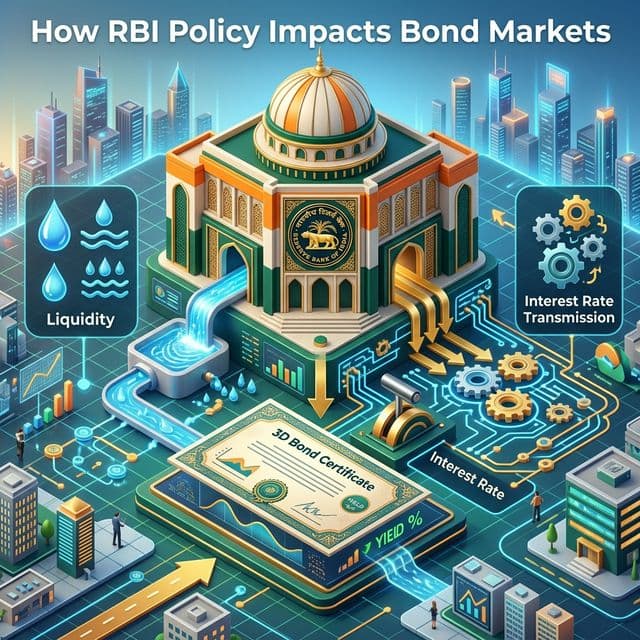
How RBI Policy Impacts Bond Markets: Transmission, Liquidity, and the 10-Year Benchmark
A research-focused explanation of how RBI policy travels from the repo rate to bills, bonds, bank funding, and the Indian benchmark curve.
Convexity Core Research3 min read
The Reserve Bank of India sits at the center of the domestic rates complex because policy, liquidity management, government financing, and market signaling all intersect in the bond market. That makes RBI analysis indispensable for anyone allocating to Indian duration, credit, or rate-sensitive equities.
The key point is that the repo rate is only the visible starting point. Transmission works through a chain. Overnight funding adjusts first, Treasury bills and the front end follow, banking-system rates move next, and the long end responds through a mixture of policy expectations, inflation pricing, government borrowing, and foreign demand.
How the transmission chain works
Visual
RBI transmission moves from the overnight market to the benchmark curve
The chain begins with policy rates but ends in market pricing that reflects a broader macro mix.
The short end reacts fastest because it lives closest to the operating framework of monetary policy. If liquidity is tight and the policy stance is hawkish, front-end yields usually adjust quickly. The 10-year benchmark moves too, but its final level depends on more than policy. That is why the same repo-rate path can coexist with different 10-year outcomes under different fiscal and inflation regimes.
Why liquidity tools matter almost as much as policy rates
An RBI rate decision tells the market where the center of policy is. Liquidity tools determine how tightly money-market rates hug that center. Variable-rate reverse repos, standing facilities, and liquidity operations influence the effective short-term funding environment. That matters because the curve prices not just the policy target, but the market rate at which money is actually clearing.
Direct curve-shaping tools
Visual
Each RBI tool affects the market in a different way
Repo, liquidity tools, OMOs, and Twist operations should be read together, not in isolation.
Open market operations and Operation Twist matter because they affect the sovereign curve more directly than a plain policy-rate signal. OMOs can absorb or inject duration into the system. Twist operations can flatten or steepen specific maturity segments without sending the same broad message as a repo change.
The role of fiscal supply
No serious analysis of Indian bonds is complete without the borrowing calendar. A large government borrowing program places persistent supply on the long end, especially around benchmark tenors. Even when inflation softens, the term premium embedded in the 10-year can stay sticky if supply remains heavy or if markets worry about future fiscal slippage.
Chart
Illustrative market reaction across the curve after a hawkish RBI surprise
Short-end yields tend to move first, but fiscal and inflation pricing can keep the long end elevated too.
Yield change
X-axis: MaturityY-axis: Change in yield (bps)
This is why the 10-year G-Sec becomes the market's clearing price for more than sovereign debt. Corporate issuance, state borrowing, loan pricing, and discount rates all key off that benchmark.
What to watch after every RBI meeting
The headline rate decision matters, but it is rarely enough. The more useful checklist is:
was the decision in line with expectations or a surprise?
did the stance turn more restrictive or more balanced?
what did the guidance imply for the next two meetings?
what did the RBI signal on liquidity and bond operations?
That is the framework that determines whether the curve bull-steepens, bear-flattens, or simply digests the event quietly.
Final takeaway
RBI policy affects the bond market through three interacting pillars: the policy path, the liquidity regime, and the fiscal supply backdrop. Looking at only one of those pillars leads to shallow conclusions. Looking at all three together gives a much better view of why the front end, the belly, and the 10-year benchmark are moving.
A research deep dive into the concept of fiscal dominance, explaining how high government interest expense shapes monetary policy options and sovereign debt markets.