Fiscal Dominance: What Happens When High Government Debt Constraints Central Banks
A research deep dive into the concept of fiscal dominance, explaining how high government interest expense shapes monetary policy options and sovereign debt markets.
Convexity Core Research4 min read
Monetary economics operates on the assumption of monetary dominance. Under this regime, the central bank is free to adjust interest rates to achieve its inflation target. If inflation rises, the central bank raises rates to cool demand; if inflation falls, it cuts rates. The government's fiscal stance is assumed to adjust passively to ensure long-term debt sustainability.
However, when sovereign debt reaches extreme levels, this assumption breaks down, leading to fiscal dominance. In this scenario, the sheer volume of government debt and the cost of servicing it begin to dictate the path of monetary policy. Central banks lose their operational independence, not through political pressure, but through mathematical necessity.
Historical Inflection Points
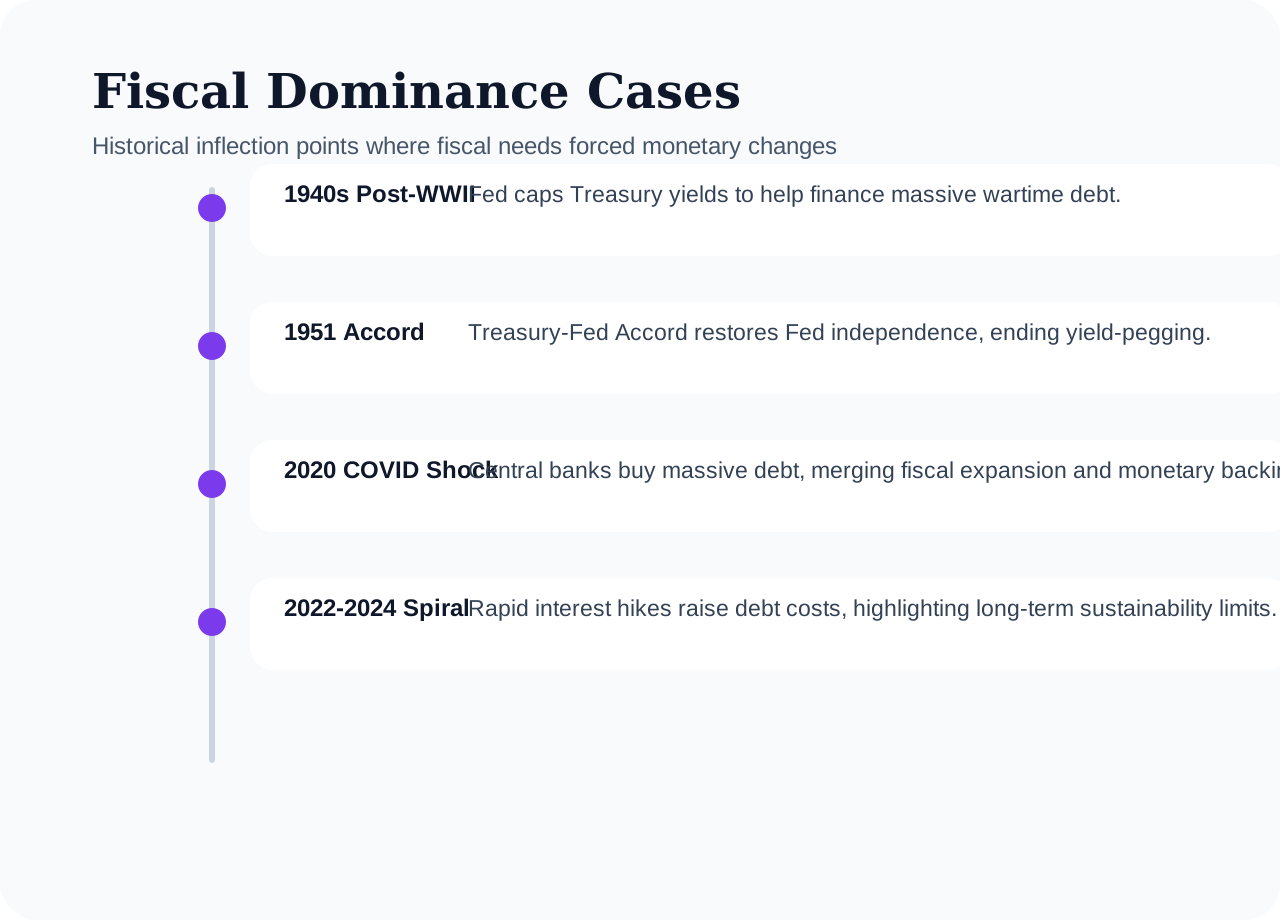
To understand how fiscal dominance develops, we can look at historical regimes where government financing constraints took precedence over inflation-targeting mandates:
Visual
Historical instances of fiscal dominance
Inflection points where sovereign debt requirements dictated central-bank policy limits.
The Interest Expense Spiral
The core transmission mechanism of fiscal dominance is the government's interest bill. When a sovereign is highly leveraged, even a minor increase in interest rates translates into a substantial increase in annual interest expenses.
Visual
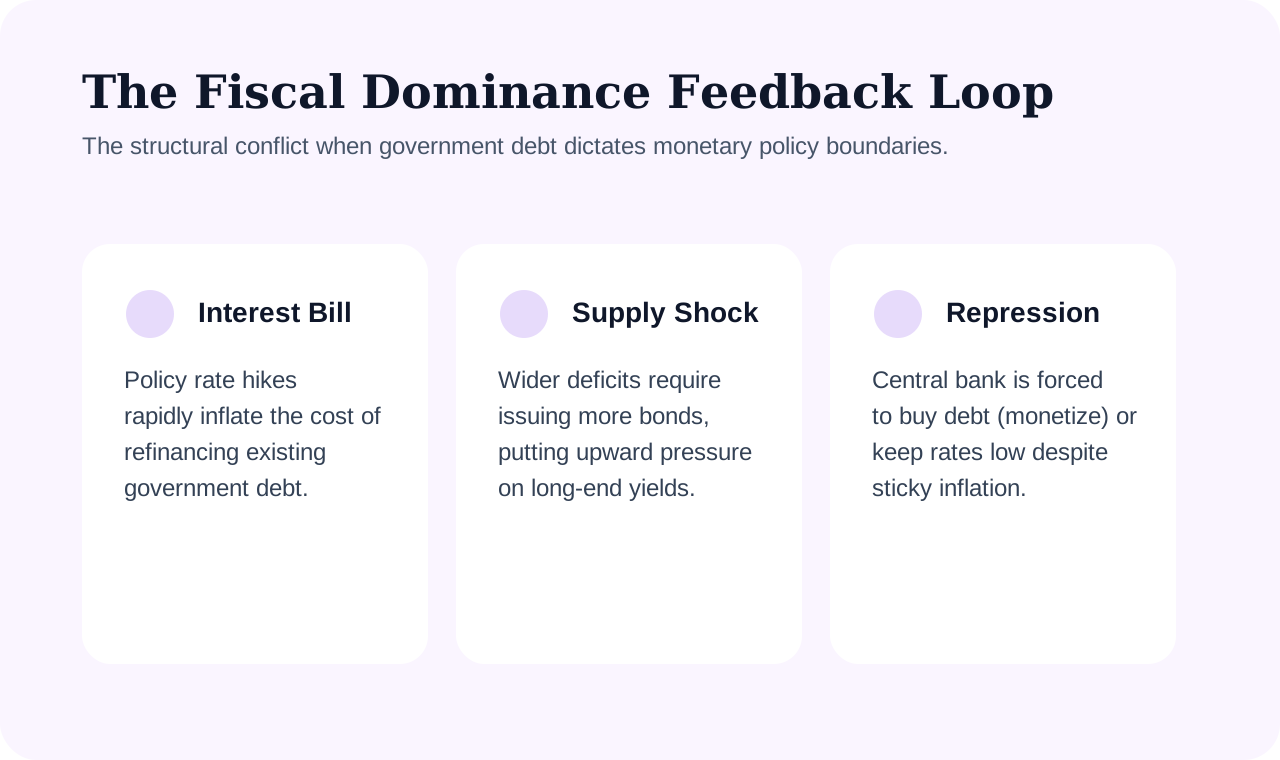
The self-reinforcing loop of fiscal dominance
How rate hikes can feed back into higher debt supply and force central-bank intervention.
As a central bank raises rates to fight inflation, the government's cost of borrowing rises. This increases the fiscal deficit, forcing the government to issue even more bonds to finance its interest payments. If the deficit widens faster than the rate hikes can suppress demand, the policy change actually becomes expansionary, adding to inflation rather than cooling it. This is the paradox of fiscal dominance.
The Mathematics of Sustainability
Sovereign debt sustainability is governed by the relationship between the real interest rate ($r$) and the real growth rate of the economy ($g$).
If $r < g$, the economy can grow out of its debt over time, even with modest primary deficits.
If $r > g$, the government must run primary surpluses to prevent the debt-to-GDP ratio from rising indefinitely.
When interest rates remain structurally higher than the growth rate, the debt trajectory becomes unstable.
Chart
US Public Debt Projections: Baseline vs High Interest Scenario
If interest rates exceed nominal growth, the public debt-to-GDP ratio enters an exponential trajectory.
X-axis: Projected Years (2025 - 2045)Y-axis: Debt Held by the Public (% of GDP)
In this simulation, we compare a stable growth baseline against a scenario where interest rates remain high while growth slows. The divergence shows why central banks are hesitant to keep rates elevated for long periods when sovereign leverage is high.
Policies of Financial Repression
When fiscal dominance takes hold, central banks and governments often resort to financial repression to manage the debt burden. These policies aim to keep nominal interest rates below the rate of inflation, resulting in negative real interest rates that erode the real value of the debt. Common tools include:
Yield Curve Control (YCC): The central bank caps long-term sovereign yields by committing to purchase unlimited quantities of bonds at a target price.
Regulatory Mandates: Financial institutions (such as banks and pension funds) are required to hold minimum percentages of sovereign debt, creating captive demand.
Capital Controls: Restrictions on moving capital abroad to force domestic savings to stay within the sovereign debt system.
Monetary Dominance vs. Fiscal Dominance
To guide researchers, we can summarize the differences between the two economic regimes:
Table
Key Differences: Monetary Dominance vs Fiscal Dominance
A comparison of policy priorities, transmission channels, and market impacts under the two regimes.
Dimension
Monetary Dominance
Fiscal Dominance
Primary Policy Goal
Price stability (inflation target)
Sovereign solvency & debt service
Central Bank Status
Independent, sets rates freely
Constrained by government interest costs
Deficit Financing
Taxes and public debt issuance
Debt monetization (money printing)
Interest Rate Regime
Positive real interest rates
Financial repression (negative real rates)
Bond Market Impact
Yields reflect growth and inflation
Yields capped or driven by supply shocks
Portfolio Implications for Fixed-Income Investors
For fixed-income managers, fiscal dominance alters the risk-return calculation:
Sticky Inflation: Real interest rates remain negative or low, meaning cash and nominal bonds can lose purchasing power over time.
Higher Term Premium: Investors demand higher compensation for holding long-duration assets due to the risk of fiscal supply shocks.
Asset Allocation Shift: Real assets, inflation-linked bonds (TIPS), and commodities become essential additions to preserve capital.
Ultimately, fiscal dominance means that monetary policy cannot be analyzed in isolation from fiscal policy. When debt is high, the budget deficit is a rates variable.